How Does Chinese Word Counting Work?
When you count words in English, you can often get a result by separating text wherever there is a space. Chinese works differently.
Chinese text is usually written as a continuous sequence of characters without spaces between every word. Because of this, a Chinese word counter cannot simply count spaces. It first needs to determine which characters belong together as meaningful word units.
This process is called Chinese word segmentation.
For example:
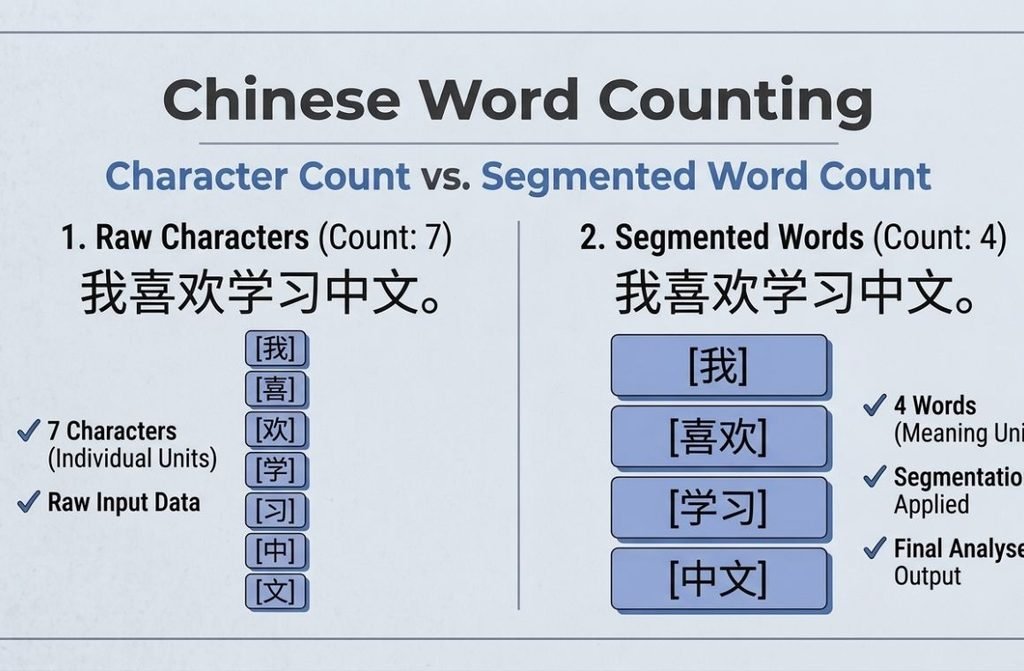
我喜欢学习中文。
A character counter can count the individual characters directly. A Chinese word counter has a different job: it needs to decide how the characters should be grouped.
You can use our Chinese Word & Character Counter to analyze Chinese text and compare word and character statistics.
One possible segmentation is:
我 / 喜欢 / 学习 / 中文
Chinese word counting is not just counting characters. It is the process of identifying word units within continuous Chinese text.
Table of Contents
What Happens When You Count Chinese Words?
A Chinese word counter generally performs several stages of analysis.
The exact method can vary, but the overall process can be understood like this:
Chinese text → identify characters → find possible word boundaries → group characters → count word units → display the result
Let’s look at each stage.
Step 1: The Counter Reads the Text
First, the tool receives the Chinese text you enter.
For example:
我喜欢学习中文。
At this point, the text is simply a sequence of Chinese characters.
The counter does not yet need to decide how many words there are.
It first needs to recognize the text that it has been given.
Step 2: The Text Is Examined Character by Character
The software can identify the individual characters in the sequence.
For:
我喜欢学习中文。
the characters are:
我、喜、欢、学、习、中、文
There are 7 individual characters.
This is a character-counting task.
Chinese word counting goes one step further.
The software must now determine how those characters can be grouped.
Step 3: The Counter Looks for Word Boundaries
This is the most important part of Chinese word counting.
In English, you might see:
I like Chinese.
The spaces provide visible boundaries:
I | like | Chinese
In Chinese, you may see:
我喜欢中文。
There are no spaces showing where the word boundaries are.
The counter therefore has to estimate where one word ends and another begins.
For example, it may interpret the text as:
我 | 喜欢 | 中文
The boundaries are created by the analysis rather than by visible spaces in the original sentence.
Step 4: Characters Are Grouped Into Word Units
After possible boundaries are identified, the software groups characters together.
Consider:
学生
The two characters are:
学 | 生
But they can function together as:
学生
The counter therefore treats the sequence as a word unit rather than automatically treating every character as a separate word.
This same principle applies throughout a longer passage.
Step 5: The Word Units Are Counted
Once the text has been segmented, the identified units can be counted.
Try our Chinese Word & Character Counter to see Chinese word and character statistics in practice.
For example:
我 / 喜欢 / 学习 / 中文
contains:
4 word units
while the original text contains:
7 Chinese characters
This is why a Chinese word count and Chinese character count can produce different numbers for the same text
What Is Chinese Word Segmentation and Why Is It Necessary?
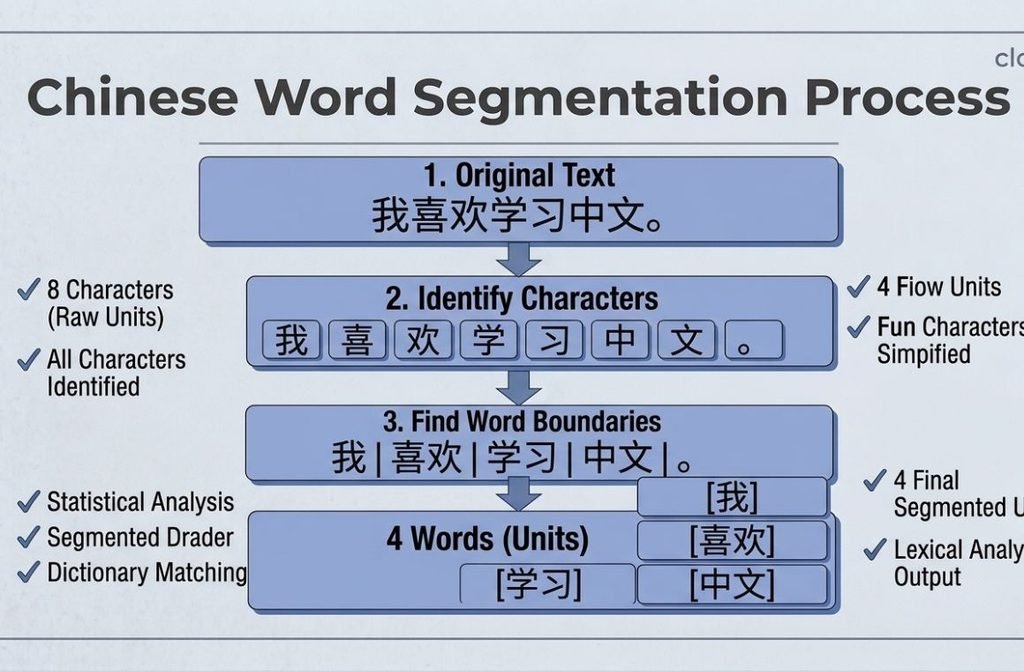
Chinese word segmentation means dividing continuous Chinese text into smaller units that represent words.
For example:
今天我学习中文。
A possible segmentation is:
今天 / 我 / 学习 / 中文
The software is trying to determine which characters belong together.
This is important because Chinese writing usually does not use spaces to visibly separate individual words.
Segmentation is therefore one of the central tasks behind Chinese word counting.
A reader can understand the sentence from language knowledge and context.
A computer needs a method for making a similar decision.
That is why a Chinese word counter needs more than a simple space-based counting rule.
Why Can’t a Chinese Counter Simply Count Every Character?
Because a character and a word are not always the same thing.
For example:
学生
contains two characters:
学 + 生
but the two characters work together as one word.
Another example is:
电脑
which contains two characters but functions as one word.
If a counter treated every Chinese character as one word, it would often produce a misleading word count.
Chinese word counting therefore needs to consider groups of characters, not just individual characters.
A request for 1,000 Chinese characters is therefore not the same as a request for 1,000 Chinese words. The two measurements describe different things.
Character counting measures individual written characters.
Word segmentation analyzes how those characters function together as language.
Why Can Two Chinese Word Counters Show Different Results?
The same sequence of characters can sometimes be grouped differently depending on context.
Suppose you paste the same Chinese paragraph into two different tools.
One tool might report one number.
Another tool might report a slightly different number.
There are several possible reasons.
Different word dictionaries
One tool may recognize a particular group of characters as a known word while another may treat the sequence differently.
Different segmentation rules
The tools may use different rules for deciding where word boundaries should be placed.
Different handling of names
Personal names, place names, organizations, and other proper names may be handled differently.
Different treatment of unusual expressions
Technical terms, newer vocabulary, abbreviations, and uncommon phrases can make segmentation more difficult.
Different counting policies
A tool may also have its own rules for punctuation, English text, numbers, spaces, and other content.
So a different result does not automatically mean that one counter is broken.
The tools may simply be using different counting methods.
Chinese word counting cannot always produce one universally agreed result for every type of text. Names, technical terms, unusual expressions, new vocabulary, and mixed-language content can make segmentation more difficult.
How Numbers and English Affect Chinese Word Counting
Real-world Chinese text is not always made up of Chinese characters alone.
You may see text such as:
我今天读了3篇English articles。
This contains:
- Chinese characters
- a number
- English letters
- spaces
- an English word
A counter may process these categories separately.
This is important when you are working with:
- bilingual documents
- translated material
- websites
- subtitles
- social media posts
- academic writing
For mixed-language text, always check what your particular counter includes in its word and character statistics.
How Does Punctuation Affect the Count?
Chinese text may include punctuation such as:
。 , ! ? 、 “ ” ( )
These marks are not the same as Chinese characters.
A word counter may handle punctuation separately when identifying word units.
For example:
我喜欢中文!
The exclamation mark does not automatically become a Chinese word.
However, a tool may display punctuation as part of a broader text-statistics report.
Always check how your counter handles punctuation when interpreting the results.
How to Count Chinese Words Online
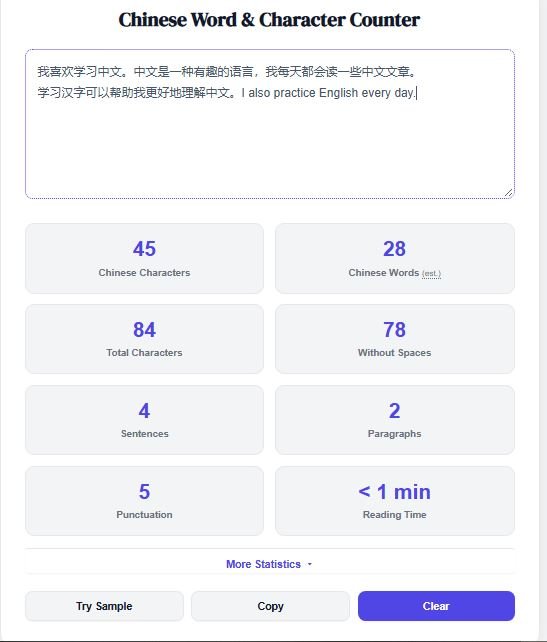
To check the Chinese word count of your own text:
- Open our Chinese Word & Character Counter.
- Paste your Chinese text into the input area.
- Let the tool analyze the text.
- Review the Chinese word result.
- Compare it with the character count when necessary.
For example, you might enter:
我喜欢学习中文。
The tool can then provide the relevant statistics according to its counting method.
This is much easier than trying to identify every word boundary manually in a long document.
The same process works with longer articles. You can paste a complete passage into the tool and let it analyze the text automatically instead of identifying every word boundary manually.When Should You Use Chinese Word Count vs Character Count?
When Should You Use Chinese Word Count vs Character Count?
When should you check Chinese word count?
Chinese word counting can be useful when you want information about the linguistic size of your content.
For example, you may want to check it when:
- studying Chinese text
- analyzing an article
- preparing translated content
- reviewing written material
- comparing passages
- researching language
- examining how text is segmented
It can give you a different perspective from simply counting characters.
When should you check Chinese word count?
Use character counting when the requirement is specifically based on characters.
For example:
- a writing assignment asks for a certain number of characters
- a form has a character limit
- a platform limits the length of a field
- you need to compare the size of Chinese passages
- you are checking a short title or description
In these situations, a character count is more appropriate than trying to substitute a word count.
Why a Simple Character-to-Word Formula Does Not Always Work
It can be tempting to assume that Chinese word count can be calculated from character count using one fixed formula.
That approach is not reliable for general Chinese text.
Different words can contain different numbers of characters.
For example:
人
can function as one character and one word.
But:
学生
contains two characters and can function as one word.
Longer words can contain even more characters.
This means there is no universal rule that says a fixed number of Chinese characters always equals a fixed number of words.
A real word-counting process needs to consider the structure of the text.
What Should You Look for in a Chinese Word Counter?
When choosing a tool, look for clear information about what it measures.
A useful counter may provide statistics such as:
- Chinese words
- Chinese characters
- total characters
- sentences
- paragraphs
- numbers
- English letters
- punctuation
- spaces
The most important thing is that the tool explains its measurements clearly enough for you to understand the result.
The most useful counter is one that clearly explains what each measurement means.
A Practical Example
Let’s use:
我喜欢学习中文。
Character view
The text contains:
我 / 喜 / 欢 / 学 / 习 / 中 / 文
7 Chinese characters
Word view
A possible segmentation is:
我 / 喜欢 / 学习 / 中文
4 word units
Once the boundaries are identified, the word units can be counted.
Once the boundaries are identified, the word units can be counted.
Chinese Word Counting in Everyday Use
You do not need to understand computer algorithms to use a Chinese word counter effectively.
The practical idea is simple:
Paste your text → let the tool segment it → review the word count → compare with the character count when needed.
The deeper concept is that the tool is trying to identify meaningful groups of characters within continuous Chinese writing.
Once you understand that process, Chinese word-count results become much easier to interpret.
Frequently Asked Questions
How does Chinese word counting work?
A Chinese word counter analyzes continuous Chinese text, identifies likely word boundaries, groups characters into word units, and counts those units.
Why doesn’t Chinese word counting simply count spaces?
Chinese normally does not use spaces between every word, so spaces cannot provide all the word boundaries needed for counting.
What is Chinese word segmentation?
Chinese word segmentation is the process of dividing continuous Chinese characters into meaningful word units.
Is Chinese word count the same as character count?
No. Character count measures individual written characters, while word count measures identified word units.
Why can two Chinese counters show different word counts?
Different counters can use different segmentation rules and handling methods, so they may group some character sequences differently.
Can Chinese word counters handle English and numbers?
Many counters can analyze mixed Chinese, English, and numeric content, but the exact statistics depend on the tool.
Should I use word count or character count?
Use word count when you need information about word units. Use character count when you have a character-based requirement.
Can I calculate Chinese word count from character count?
Not reliably with one universal formula. Chinese words can contain different numbers of characters, so word count depends on segmentation.
Final Thoughts
Chinese word counting is different from ordinary space-based word counting because Chinese text normally does not show word boundaries with spaces.
A Chinese word counter therefore has to do more than count characters. It has to analyze the text, identify possible boundaries, group characters into word units, and then count those units.
The most important distinction is:
Character counting measures written characters.
Word counting analyzes word units.
Once you understand how segmentation works, it becomes much easier to understand why Chinese word counts can differ and why character count and word count should be used for different purposes.
You can try our Chinese Word & Character Counter to analyze your Chinese text and see its word and character statistics online.